Negative Reviews Can Only Hurt a Company if
Let'south face it: getting a negative review can feel like a punch to the gut. Later all, your brand is laser-focused on developing products and experiences that your customers beloved. And it's never fun to hear negative feedback virtually something yous've worked hard to create.
But negative reviews are inevitable. Even the most well-loved businesses get them from time to time. That'southward considering it's simply impossible to create a production that meets the needs of every single customer who comes your fashion.
Of course, negative reviews are never the end goal. Just the good news is, there's a positive side to negative reviews. Yes, you read that right. In fact, i and two star reviews can really be good for your business organization.
Not convinced? Permit'south explore how negative reviews can positively affect your brand — and three central actions you can accept to get the most benefit from your one and two star reviews.
How Negative Reviews Benefit Your Make
In an ideal world, every i of your customers would write glowing reviews for the products they purchase. Merely that's not reality. And that'southward OK.
Getting the occasional one or 2 star reviews doesn't mean your business organisation is going under. In fact, one or two star reviews tin benefit your business organisation in these 4 fundamental ways.
Negative Reviews Help you Build Trust with Shoppers
Today, consumers have literally endless shopping options. Of course, there are dozens of things a consumer considers when determining which companies to do business with — and which to laissez passer upwards. But one top consideration is trust.
Research from Edelman found that 81% of consumers say they must be able to trust a brand prior to making a buy. And 70% indicate trusting a brand is more than of import now than in the past.
In order to earn that trust, brands must be transparent. And a key manner to exercise that is to display feedback from other shoppers — including the negative kind. When shoppers see negative reviews, they run into you take naught to hide. And that lets them know you're a brand they can trust.
Negative Reviews Increase Product Sales
You might presume that the higher the average star rating of a product, the more likely a shopper is to buy it. And that's true — up to a bespeak.
We partnered with Northwestern Academy and made an interesting discovery, though. We found that a shopper is actually more likely to buy a product when it has some negative reviews.
In fact, our research found that purchase probability peaks when a product'southward boilerplate star rating is betwixt iv.2 and 4.5 (it varies a chip by product category). If the average star rating surpasses four.five, the likelihood of purchase actually drops.
Let'due south await at an case. In the chart below, we can come across that the purchase probability for salon haircare products peak at 4.4 stars. When the boilerplate star rating surpasses four.4, the purchase probability goes down. In other words, a shopper is more likely to purchase a product with an boilerplate star rating of 4.4 than one with a five star rating.
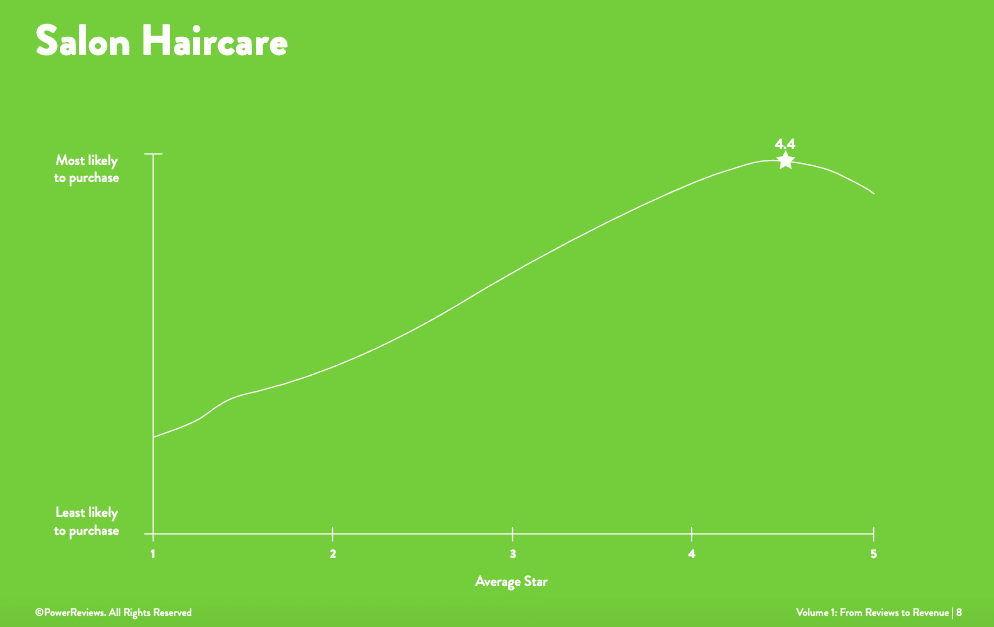
Only why is that the instance? Because consumers perceive products with perfect 5 star ratings every bit too good to be true. If in that location are no negative reviews, a shopper may even jump to the conclusion that a make is hiding something — and that they shouldn't be trusted.
On the other hand, the occasional negative review can actually boost sales of a product, as this content brings your average star rating closer to that sweet spot of 4.2-4.5
Negative Reviews Help Consumers Brand Better Buy Decisions
Shoppers depend on negative reviews to determine which products fit their needs — and which don't. Our research plant that a staggering 85% of shoppers seek out negative reviews.
To elaborate on why this may be the example, our research also highlights that a 3rd of shoppers say that poor reviews gave balance to their shopping research, stating that a negative perspective was either a 'very important' or 'important' factor influencing their decision.
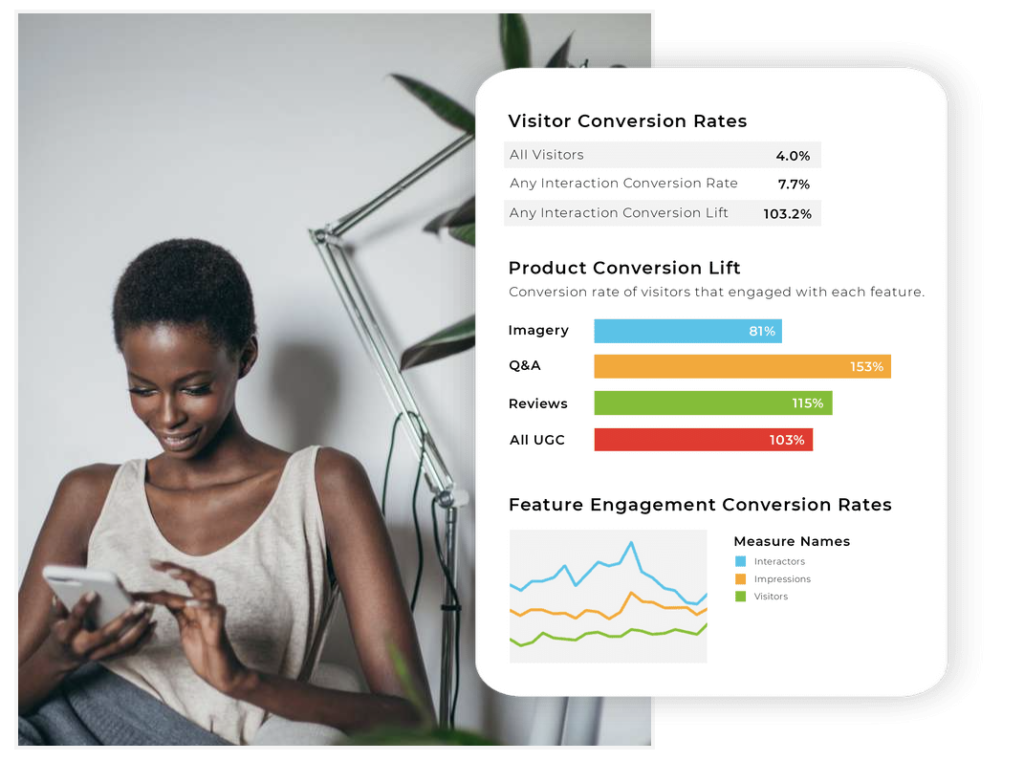
In fact, when researching products, 2-thirds of ecommerce shoppers filter for one-star reviews. These visitors still convert at 108% the rate of general spider web traffic (incidentally, this is the type of insight our PDP Site Analytics solution routinely surfaces).
Only why is this the example? Here are three things nosotros've noticed from speaking to brands and looking at this data twenty-four hour period-in, twenty-four hours-out:
1. Based on the negative reviews, the shopper determines the product isn't a expert fit for their needs. They continue searching for a production that's a better match — and you avoid an unhappy client and an unnecessary return.
2. The shopper determines the feedback in the one and two star reviews isn't relevant to them– so they condone it. For example, let's say a shopper is looking for shoes for their toddler. They scroll to the reviews and filter to meet only i and ii star content. Most of the negative reviews are focused on how the shoes aren't good for kids with broad feet. The shopper's daughter doesn't accept wide feet, then this feedback isn't relevant. She decides to purchase the shoes anyhow.
3. The shopper determines the worst case scenario isn't a concern — so they buy the product anyhow. For example, imagine a shopper is researching dining tables. She filters to see just ane and 2 star reviews to better empathize the absolute worst example scenario. Most of the negative reviews are focused on difficult assembly. This particular shopper is very handy and enjoys edifice furniture — and then she doesn't find this concerning. In fact, she sees this feedback as a trouble with the reviewers rather than the product itself
In each of these 3 situations, negative reviews helped a shopper brand a more informed buy decision. Of grade, when shoppers are happy with their purchases, they're more likely to become loyal — and a lot less probable to return the merchandise they bought.
Negative Reviews Shed Lite on Fixable Problems
One and two star reviews can aid y'all identify problems with your products or services that you may not have known about otherwise. This feedback can assistance inform improvements that'll allow you lot to meliorate serve your customers.
For example, let's say you sell a children's play kitchen that has a high return rate. Unfortunately, y'all don't have much information on the reasons for the returns. However, you lot notice the production has a pretty low average star rating. And several of the reviews mention that the product was impossible to assemble because the pieces didn't line up correctly.
So, y'all bring this feedback to your manufacturer to improve the quality control process for the product. And and so, you observe how the average star rating goes up subsequently this improvement.
Three Ways to Leverage Negative Reviews to Boost Your Bottom Line
So negative reviews can positively bear on the performance of your brand. In fact, they should exist viewed equally an opportunity to do just that.
Hither are three means how:
one. Display Negative Reviews
It might be tempting to filter out negative reviews. But avoid the temptation. One and 2 star reviews add a layer of authenticity to your content and permit shoppers know you're a brand they can trust. What's more, negative reviews help your shoppers make more informed purchase decisions, which will aid subtract returns and boost loyalty.
So be sure to display all reviews, regardless of star rating.
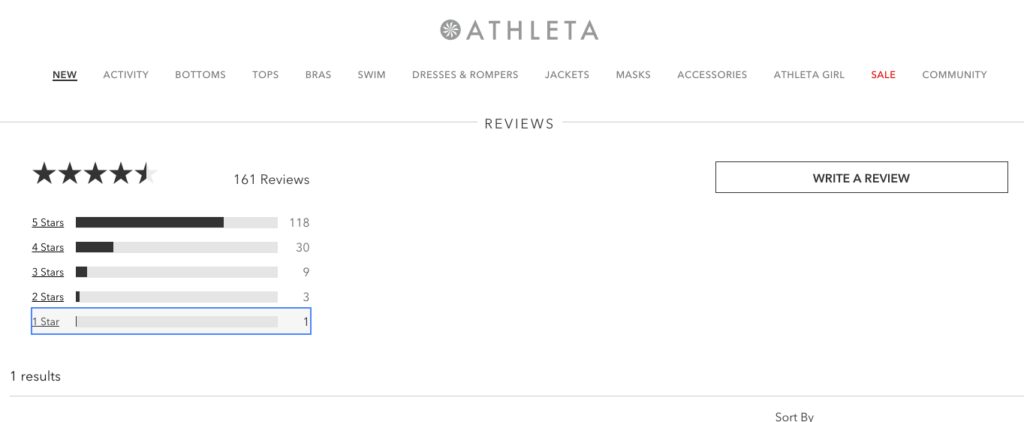
In addition, allow shoppers to easily spot the "worst instance scenario" — and decide whether it'south relevant or important to them. Our friends at Athleta do this in a couple dissimilar ways. First, shoppers tin filter reviews by a specific star rating.
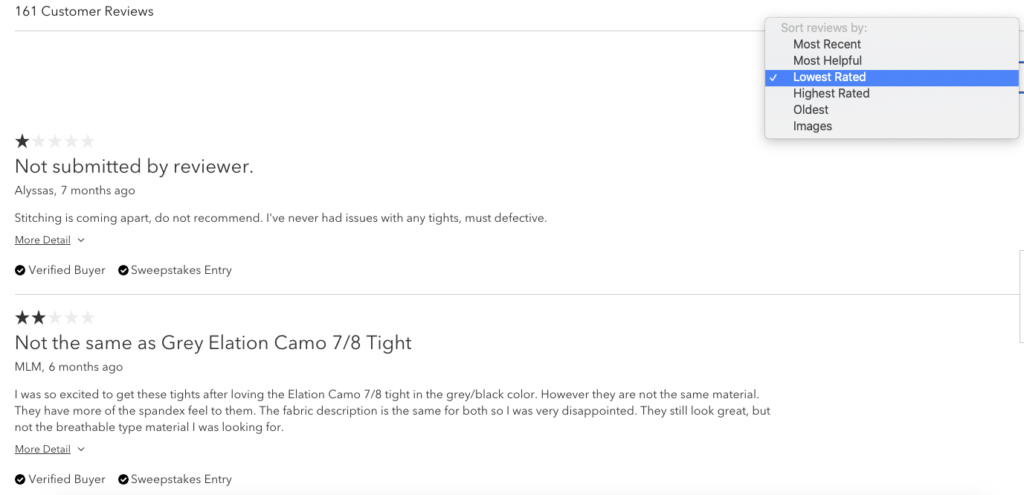
Shoppers tin can as well sort reviews by the lowest rating.
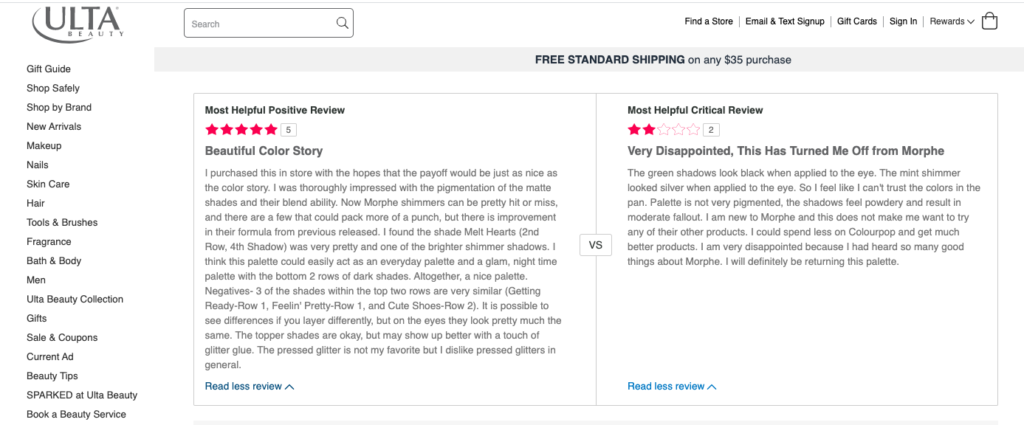
Finally, consider displaying the most helpful positive review alongside the most helpful negative review for a given product, equally our friends at ULTA practise. Again, this is a great way to help shoppers hands identify the worst case scenario. And this helps them discover the products that best fit their needs.
2. Respond to Negative Reviews
When you lot become a negative review, don't just cross your fingers and hope it'll chop-chop get covered upward past positive reviews. Instead, confront the review head-on by responding to it.
When you respond to a negative review, yous have the opportunity to turn a bad situation around and save a relationship with your customer. If you lot're able to fix the issue, the shopper is likely to buy from you lot again. What's more than, your response will show future shoppers that you value your customers and are committed to helping them resolve their issues. And that'll give these new customers the confidence they need to make a purchase.
Remember: when information technology comes to responding to negative reviews, time is of the essence. If a customer is left hanging, they'll just get more upset.
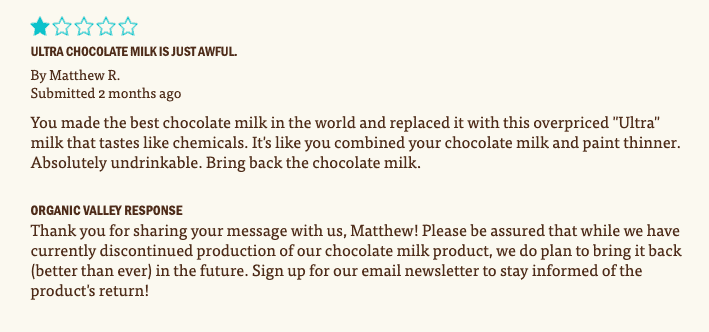
In addition, avoid using a generic, canned response — and don't go defensive. Instead, personalize your response by using the shopper's proper name and address the specific bug raised in the negative review. Our friends at Organic Valley do a great job writing personalized responses to negative reviews.
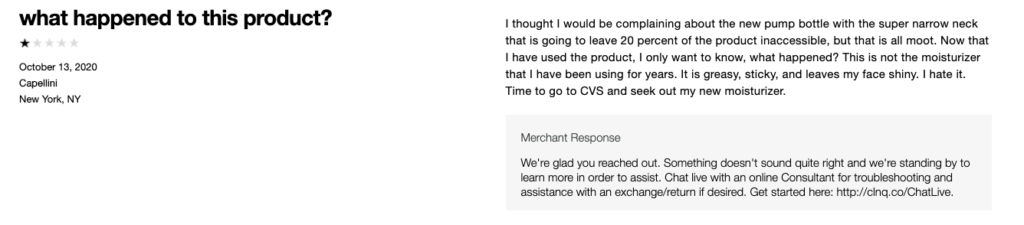
Finally, take things offline when needed. Sometimes you'll need more details from the shopper in club to resolve their issue. But be certain to post a public response also, as it'll let the customer (and futurity shoppers) know you're taking action. Here's a great example of a response from our friends at Clinique, inviting the reviewer to do a live conversation to resolve their result.
3. Analyze Negative Reviews to Identify Actionable Insights
In some cases, a negative review might mention an isolated upshot. For example, a product might exist damaged in transit.
But in other cases, a negative review can point to a larger issue that needs to be addressed. For instance, one of our customers noticed several negative reviews for a sentinel that mentioned a broken clasp. They rectified the problem and their ratings later on improved.
Be sure you lot're regularly analyzing your review content to gauge sentiment and identify problems early. Then, utilize the insights you uncover to ameliorate your products or messaging/marketing of those products or whatever else the data says needs adjusting.
With the right tool, y'all can also criterion confronting your competitors. Compare by product rating, sentiment, key themes and and so on by product, brand, and product category. This is critical insight to improving overall strategic direction and performance.
Start Embracing Negative Reviews
No business concern sets out to get negative reviews. Just – if you are faced with a scenario where yous do receive them – they are authentic and honest feedback from real customers. So the last thing you should do is brush them under a metaphorical carpet.
Rather than being fearful of negative reviews, start embracing them. Non only are they a key tool that shoppers depend on to make confident purchase decisions, they're full of insights that can help you improve your products and business, better serve your customers and ultimately generate more revenue.
Source: https://www.powerreviews.com/blog/3-ways-to-leverage-negative-reviews/
0 Response to "Negative Reviews Can Only Hurt a Company if"
Post a Comment